
Reimagining of Westin - Part 2

Updated: May 7
Why this matters
This story matters because it shows how a company’s real value lives in what its people know—and in how that knowledge is shared. At Westin, 20,000 pages and 5,000 topics weren’t just paperwork; they were the coiled memory of how we served guests, led teams, and kept our promises. By making that memory visible and usable, we helped a loose family of hotels become a true global brand.
Succulent reminds me that this is what growth looks like: not one big rebrand moment, but the patient layering of standards, tools, and values until everyone can see and live the same story.
The Value of a Company Resides in Its Intellectual Property
My nine years at the hotel level shaped how I thought about manuals, training, and intellectual property. The conviction finally crystallized when I joined the Westin corporate office in 1990 when Westin was still a company. Not a brand.

By the mid‑1990s, Westin had committed to becoming a global hotel company, not just a family of individual hotels. Our strategy centered on a narrow band of quality, clearly positioned among our competitors. To grow our reach and value, we had to make our intellectual property visible and usable. That meant defining the Westin experience — and proving we could deliver it consistently.
In 1993, we began a full update of our corporate manuals. I was asked to manage a “six‑week” project that became a three‑year labor of love and, ultimately, a pivot point in my career. The work grew to include:
Editing and publishing 20,000 pages of manuals
Developing Westin’s first Quality Assurance standards and inspection program
Launching the Westin Web, an intranet with 5,000 topics, 300 service standards, and linked tools in English, French, and German (We should have translated into Spanish. Westin had a dozen affiliated hotels in Mexico and thousands of Spanish‑speaking employees. But we also had a German CEO at the time, working on deals in France.)
My early years in hotel operations shaped everything I focused on:
Helping people understand expectations
Using technology to make content easy to update
Making information accessible, searchable, and practical
Providing tools — checklists, illustrations, reports — so customization is minimal and straightforward
I led a very small team of committed professionals working with subject matter experts. Together we created the first fully integrated set of Westin manuals: one voice, one template, illustrated best practices, and tools drawn from both corporate experts and hotel teams.
We also built systems to distribute and track the manuals. Each hotel received two complete sets — one for executives, one for front‑line leaders — so guidance was never locked away.

Once the manuals were in place, we developed operating standards based on AAA Four‑Diamond criteria and Westin requirements. We then partnered with a third‑party firm to design an inspection process. For the first time in more than 60 years, every Westin hotel would be measured against the same criteria. This was a critical step in shifting from “a collection of local hotels” to a true global company.
We wrote 20 checklists covering key guest touchpoints. Front‑line managers used them to train staff and clarify expectations. Inspectors used the same forms, creating transparency. From these checklists, we designed branded back‑of‑house posters as daily visual reminders. Every tool was built to express and reinforce the Westin culture.
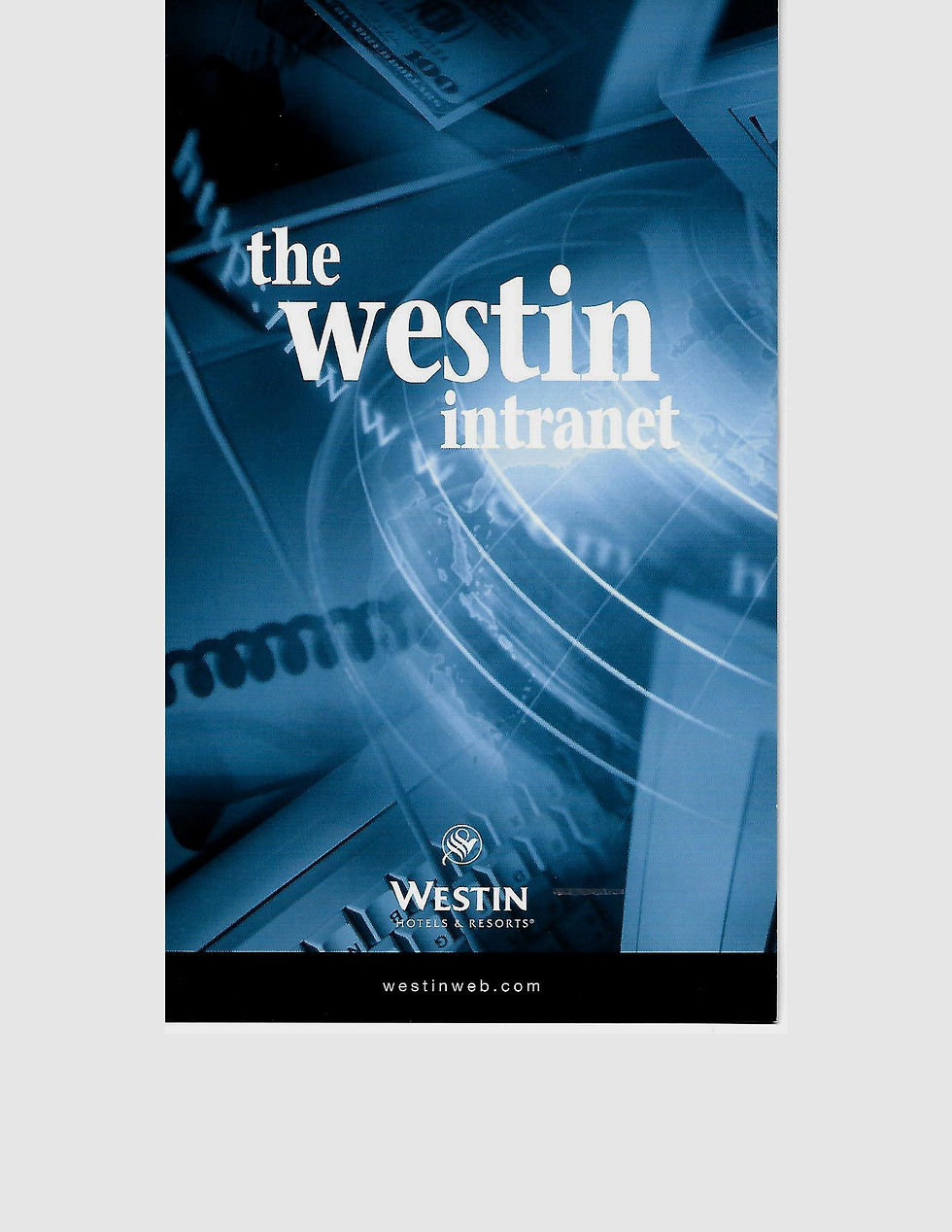
Finally, we moved the content onto a web platform — one of the industry’s first intranets. The database was searchable, and each item was coded as mandatory or
recommended. Forms and spreadsheets were linked directly to relevant topics, many of them editable for easy local use.
Those frontline years, and later my time as a trainer and project leader, became moments that mattered — for my own development and for Westin’s evolution into a transitioning into a global brand. Codifying Westin’s intellectual property helped make the company’s true value visible as it was sold to Starwood Hotels & Resorts.
Not only did Westin transform, but so did I. My time with Westin closed with the sale to Starwood. I spent my last year at the Westin corporate office helping transition standards and intellectual property to the new brand team at Starwood.
My passion for “manual labor” eventually fueled a decade of consulting. I helped more than 30 world‑class organizations — including Starbucks International, KOA, Churchill Downs, Troon Golf, Quest Diagnostics, Sol Meliá Hotels, national parks, sporting venues, grocery chains, and financial institutions — build branded content, training, standards, and websites. I traveled the globe helping companies, just as we had at Westin, bringing their brand ideals to life through clear, usable content.
Looking back, I see those 20,000 pages and 5,000 topics the way I see Succulent: what began as a single, solid form became something richer as each new layer was added with intention. The real value wasn’t just in the manuals themselves, but in what they made possible — shared language, shared expectations, and shared accountability.
In any organization, intellectual property is more than documents and databases. It’s the living memory of how you serve, lead, and keep your promises. When that memory is scattered, the brand frays. When it’s gathered, clarified, and made visible, the brand can finally hold its shape.
Succulent reminds me that transformation is rarely a single dramatic moment. It’s the patient coiling of knowledge, practice, and values into something others can see, touch, and trust. That is the quiet work of leadership: turning what we know into something the whole organization can use — and, in doing so, helping the company become its next, truer form.

Comments